
Corpus Christi Parole Office Role
The TDCJ Parole Division supervises people released from Texas prison on parole or mandatory supervision. The Texas Board of Pardons and Paroles makes parole release decisions. The Corpus Christi District Parole Office region performs supervision functions for assigned cases. It does not hold pretrial detainees, operate a county jail, decide a McMullen bond, or supply a county door-time record.
A person can be outside prison and still serve a state sentence under supervision. Parole is a discretionary Board release. Mandatory supervision is a statutory release mechanism, with different rules depending on the offense date and eligibility. A flat discharge is different because the state sentence ends without a remaining parole term.
| Situation | Responsible system | Corpus Christi parole role |
|---|---|---|
| McMullen bond release | Housing jail and court | None unless a separate TDCJ case exists |
| County probation | Court and community supervision department | Not the supervising agency |
| TDCJ parole | BPP and Parole Division | Possible regional supervision after assignment |
| Mandatory supervision | TDCJ, BPP, and Parole Division | Possible regional supervision after assignment |
| Flat discharge | TDCJ records | No continuing parole term |
Confirm Corpus Christi Parole Assignment
The official TDCJ county cross-reference maps McMullen parole and mandatory-supervision cases to the Corpus Christi District Parole Office in Region IV. That mapping is a routing aid, not proof that one named person reports there. Office assignment depends on the approved residence, release plan, supervision level, and later case changes. A McMullen conviction alone does not fix the office.
- Search the TDCJ offender record and confirm identity, state custody, and release type.
- Call the BPP parole-status line at 844-512-0461 for an individual decision or status question.
- Review the Parole Division directory and county mapping.
- Call the Corpus Christi office at 361-888-5698 and ask whether it is the correct public contact for that assigned case.
- If another office is named, use that office. Do not publish the regional mapping as a personal assignment.
Prepare the full name and TDCJ or SID number when available. Avoid relying on a name alone. A missing directory result does not establish discharge, absconder status, a warrant, or current custody.
Corpus Christi Parole Contact
The official Region IV directory provides the district office location and telephone. Confirm current hours and the assigned staff channel before travel. Public directories can change, and case-specific information can be limited by law or policy.
TDCJ Corpus Christi District Parole Office
Region IV
422 Sunbelt Drive
Corpus Christi, TX 78408
Phone: 361-888-5698
The successful capture from the TDCJ Region IV source shows the regional office listings.
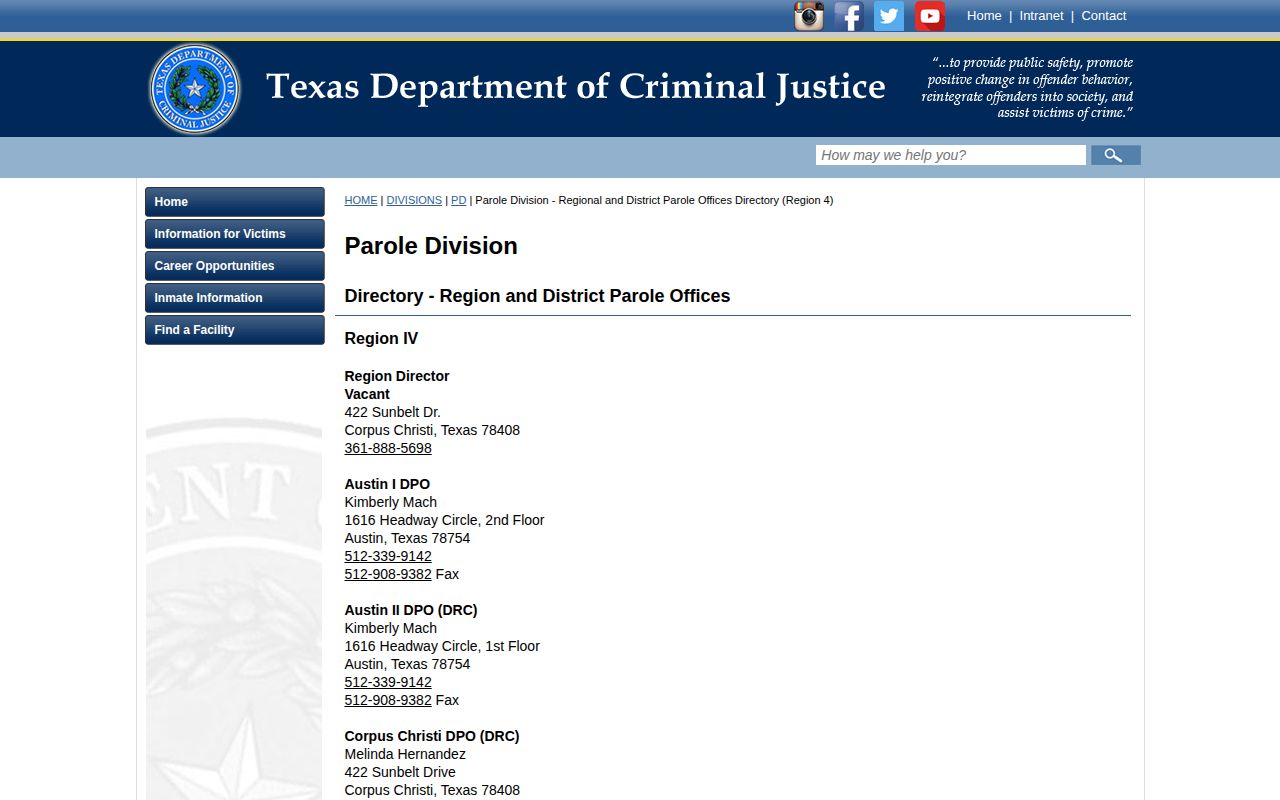
The image supports the regional contact route. It is not an individual supervision record or proof of where a person lives.
Verify McMullen Parole Status
Verification begins with the state record, not the office address. Open the TDCJ detail and compare identity, offense, county of conviction, current status, and release information. A projected release date concerns a person still incarcerated. A parole-eligibility date marks a possible review point. Neither proves that release occurred.
For an actual parole or mandatory-supervision release, identify the release type and date in TDCJ records. Then confirm the assigned district office. TDCJ operates a separate TDCJ IVSS for offered prison, parole, release, discharge, and supervision events. An automated notification is a lead, not the complete legal record.
- Parole
- Conditional release from a state-prison sentence after a Board decision.
- Mandatory supervision
- Release to TDCJ supervision under offense-date and eligibility law.
- Discharge
- The recorded end of the state sentence or supervision obligation.
- Revocation
- A formal process that can return a supervised person to custody.
- Absconder
- A person alleged to have stopped required contact or whose whereabouts are unknown to supervision staff.
Use the exact state label. Release to supervision is not sentence completion.
Corpus Christi Parole Decision Records
The Corpus Christi district office does not replace the Texas Board of Pardons and Paroles as decision-maker. Texas review is generally an administrative file review, not a public courtroom hearing with a McMullen-specific daily calendar. The Board’s monthly activity reports are aggregate and cannot prove one person’s result.
Use the BPP page, individual status line, and TDCJ detail. Voting labels can include FI variants, NR for a next review, SA for serve all, and program-conditioned outcomes. Read the current official voting definitions instead of translating every code into granted or denied.
The successful Board source capture identifies the state decision agency.
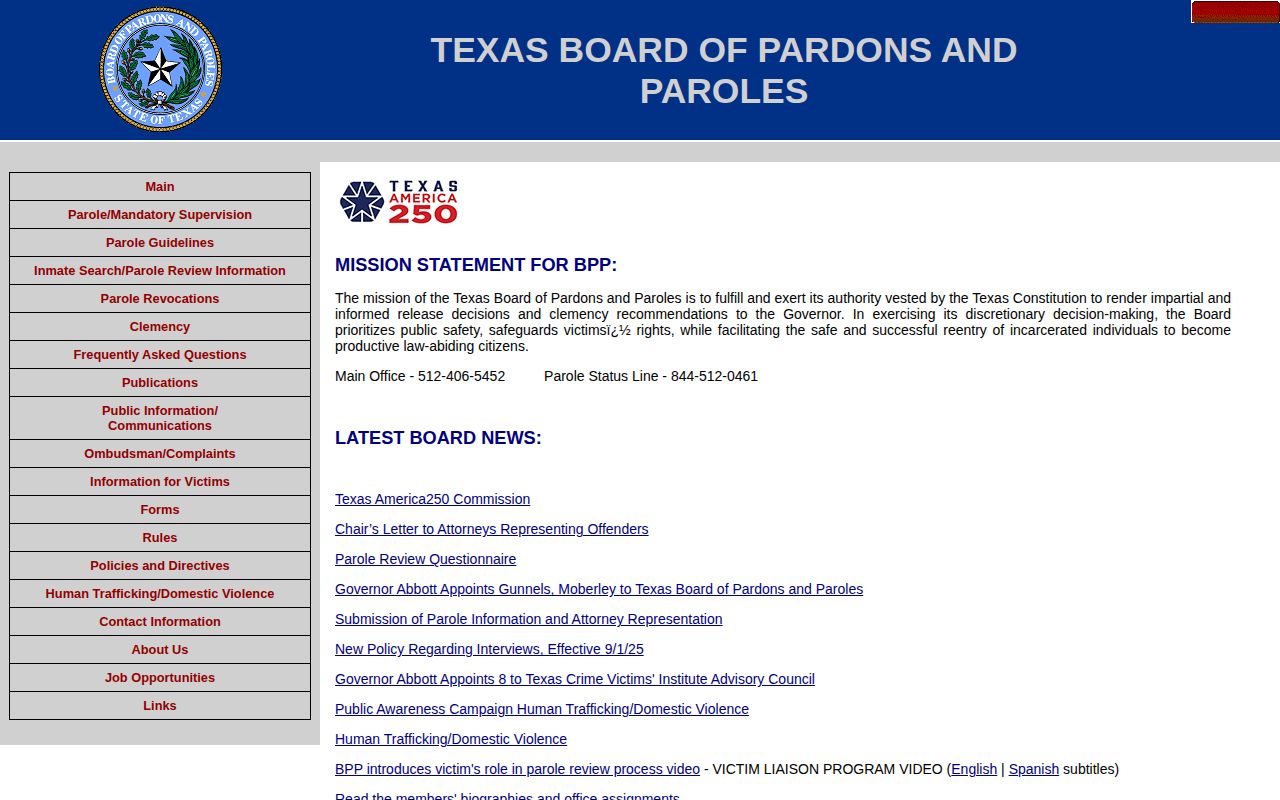
The Board record concerns a state release decision. The district office carries out supervision after assignment.
Corpus Christi Supervision Records
Conditions are stated in the release certificate, supervision plan, and other case documents. They may address reporting, travel, treatment, contact, monitoring, or duties unique to the case. General web descriptions cannot reveal every condition imposed on one person. Request or review the controlling document through the proper TDCJ channel.
A suspected violation does not itself prove revocation. A pre-revocation warrant can lead to arrest while the sentence remains active. Rescission of a release approval, revocation after release, and a new criminal charge are separate events. Confirm each through the Board, Parole Division, court, or arresting authority responsible for it.
Texas publishes no McMullen-specific parole absconder list on the county site. Do not infer wanted status from an unanswered call, a missing web result, or an old address.
Corpus Christi Supervision Discharge
Leaving prison starts supervision for a parolee or mandatory-supervision releasee. It does not end the sentence. The final state record may later show discharge, revocation, return to custody, or another status. Obtain the record from TDCJ and confirm the effective date.
County community supervision follows a different route. The McMullen clerk’s judgment can show that probation was ordered, modified, revoked, completed, or discharged. The county probation page identifies Adult Probation for the 36th Judicial District. That department, not the TDCJ district parole office, handles the local court path.
The McMullen parole and probation comparison explains the two systems in more depth. For the state path, retain the TDCJ release record, office-assignment confirmation, and final discharge or revocation record as separate items.
McMullen State Release Trail
A complete state trail can begin with a McMullen felony judgment, continue through transfer to TDCJ-CID, and later show release to parole or mandatory supervision. McMullen Sheriff controls its arrest and transport record. The clerk controls the judgment. TDCJ controls prison location, computation, and release data. The assigned Parole Division office controls supervision records within its authority.
Those stages should not be collapsed. County-jail departure to TDCJ is a transfer. A scheduled prison release is still prospective. Release to parole places the person outside prison but under state control. Discharge ends the state correctional term. Match each claim to the office that created that record.
Note: Reconfirm the assigned office for the person because approved residence and supervision needs can override the county routing map.
Parole eligibility comes from Government Code Section 508.145 and the law tied to the offense date. Section 508.149 addresses mandatory-supervision exclusions, which is a different question. First eligibility is not a scheduled release, favorable vote, or discharge. Keep official date labels intact when asking the Board or office for status.
If supervision ends, request the final record rather than infer it from an old directory entry. A discharge record shows that the state term ended. A revocation record shows a different result and may lead back to custody. A moved case may simply have a new assigned office. Each event needs its own date and source.
McMullen’s county probation channel remains separate. A local judgment can place someone on community supervision without a TDCJ prison release. The court and adult probation department verify that status. Calling the Corpus Christi parole office for every released county defendant would mix court supervision with executive-branch parole and can produce a misleading “not found” response.