
McMullen Parole Versus Probation
Texas places these forms of supervision in separate systems. Parole is a conditional release from a TDCJ prison sentence. The Texas Board of Pardons and Paroles makes parole decisions, and the TDCJ Parole Division supervises a person after release. Mandatory supervision is also a TDCJ release to supervision, but its legal basis and review rules differ from discretionary parole. Probation is the familiar name for community supervision. A judge orders it through a criminal case, often without a state-prison release. McMullen County court records and the responsible adult probation department document that path.
A person can leave a housing jail on bond while the charge stays pending. That person is not automatically on either form of supervision. Likewise, someone who leaves county custody for TDCJ has been transferred, not paroled. Start with the signed judgment and the custody record. They show which branch to follow.
| Question | Parole or mandatory supervision | Probation or community supervision |
|---|---|---|
| Who orders it? | Texas Board of Pardons and Paroles under state release law | The sentencing court in the criminal case |
| Who supervises it? | TDCJ Parole Division | The court-linked community supervision department |
| Best first record | TDCJ offender detail and BPP status | Judgment, conditions, and clerk docket |
| How it ends | Discharge, revocation, or sentence expiration shown in TDCJ records | Court or department completion, discharge, modification, or revocation record |
The TDCJ release-types page explains parole, mandatory supervision, and discretionary mandatory supervision. It should not be used to classify an ordinary McMullen County bond release.
Verify McMullen Post-Release Supervision
Verification works best as a short chain of matched official records. A name alone is weak because people can share names and because office assignment can follow an approved residence rather than the county of conviction. Use a TDCJ number, State Identification number, date of birth, case number, or other public identity field when available.
- Check the TDCJ offender search when a state-prison sentence is plausible. Compare identity, offense, county of conviction, location, and release information.
- For a parole decision or current state supervision question, call the BPP parole-status line at 844-512-0461. Do not treat an eligibility date as an approval.
- Use the Parole Division directory to confirm the assigned district office. Residence and case needs can change the assignment.
- For community supervision, obtain the judgment and conditions from the McMullen County/District Clerk. Ask which department holds the case.
- Confirm completion, discharge, modification, or revocation with the agency that owns that record. A missing web result is not proof that supervision ended.
McMullen felony matters run through a multi-county court structure. The 36th, 156th, and 343rd Judicial Districts serve several counties, and shared court material places McMullen criminal matters on the 156th District Court docket. The combined local clerk is the sound starting point for a specific case. For the broader release trail, use the McMullen County released-inmate search path.
McMullen Supervision Office Routes
Two regional contacts appear in the official research, but they serve different case types. The McMullen County probation page identifies Adult Probation for the 36th Judicial District. TDCJ separately maps McMullen parole and mandatory-supervision cases to its Corpus Christi district office in Region IV. Always confirm the actual assignment before travel or reporting because a state parole office can be based on the approved home plan.
Adult Probation, 36th Judicial District
George West office
Phone: 361-449-2733, extension 1012
Sinton office: 361-364-4243
TDCJ Corpus Christi District Parole Office
Region IV
422 Sunbelt Drive
Corpus Christi, TX 78408
Phone: 361-888-5698
The official Region IV office page is also the source of the captured office listing shown below.
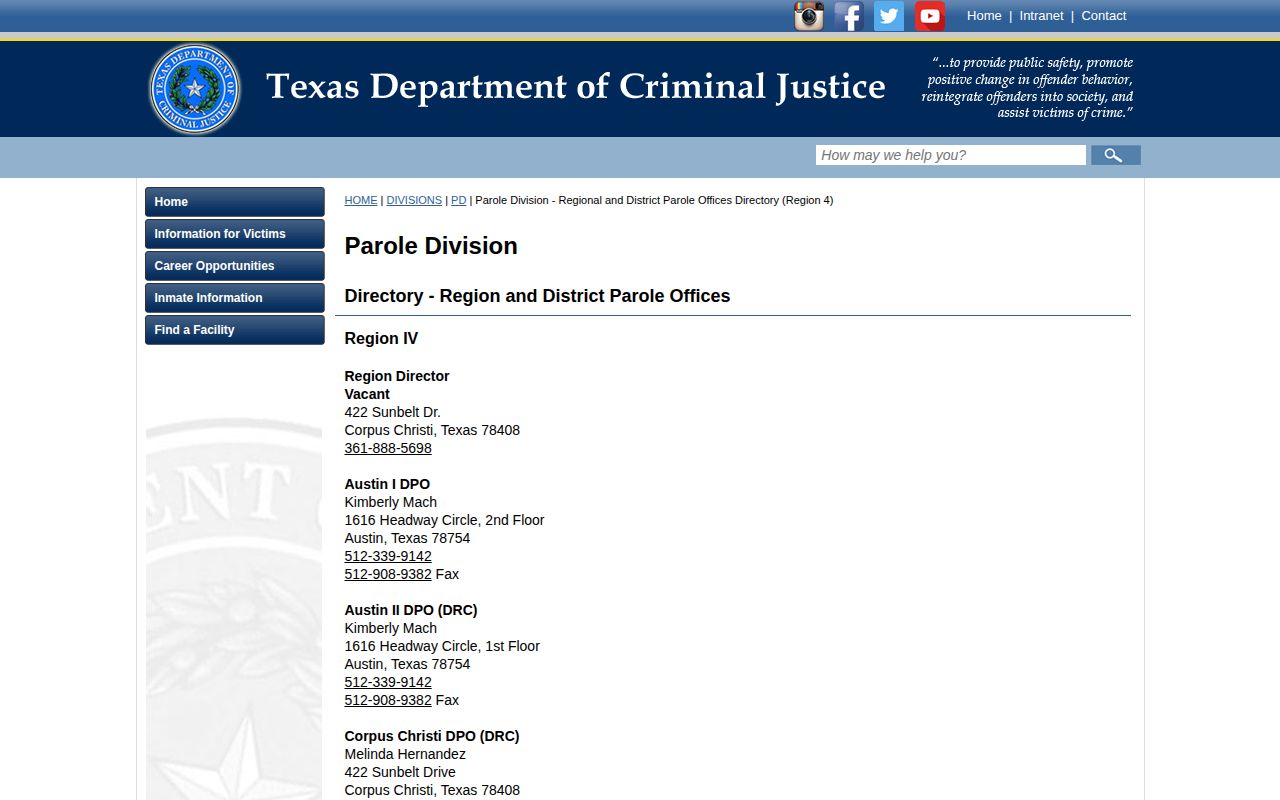
The image supports the regional parole route, while the local probation page remains the proper source for a court community-supervision case.
McMullen Parole Review Records
The Texas Board of Pardons and Paroles generally conducts an administrative file review, not a public courtroom hearing scheduled for each inmate. No McMullen-specific daily parole calendar was found. The Board publishes process material and aggregate monthly activity, but those reports cannot answer whether one named person was approved. Use the TDCJ detail and BPP status line for an individual result.
Board voting codes require care. FI can refer to further-investigation or approval variants. NR sets a next review, while SA means serve all. Some decisions depend on a program or added condition. Consult the current official voting-options definitions rather than reducing every code to a simple yes or no. Rescission of an approval and revocation after release are separate processes.
The Texas Board of Pardons and Paroles page identifies the decision-making agency and status channels in the captured view.
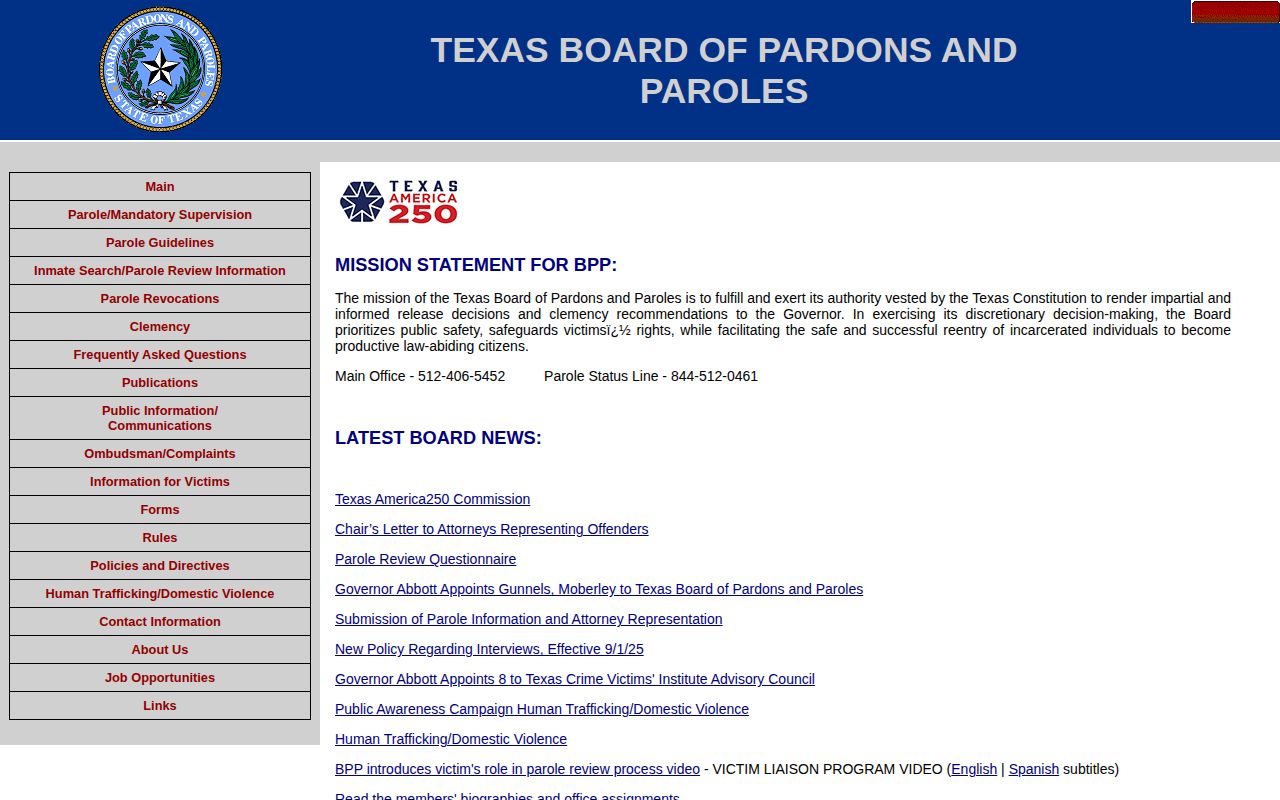
This Board source concerns TDCJ release decisions. It does not decide McMullen County probation or a county-jail bond release.
Monthly Board activity is aggregate reporting. It can show the volume and kinds of decisions during a reporting period, but it cannot stand in for an individual result or a McMullen County hearing calendar. The official review-process description explains how institutional parole staff prepare a case for panel review and how notice follows. The individual TDCJ detail and status line remain the proper channels for one person.
Eligibility depends on Government Code Section 508.145, the offense date, and offense-specific rules. Mandatory supervision under Section 508.149 is a different release mechanism. A first eligibility date does not ensure that a panel will vote then, that the vote will be favorable, or that a release plan has cleared the later audit. Keep each stage tied to its own record.
McMullen Supervision Violations
Conditions are the rules stated in a release certificate, supervision plan, or court order. They can address reporting, travel, treatment, fees, contact, or other case-specific duties. The signed document controls. General agency descriptions cannot reveal every condition imposed on one person.
A violation allegation does not itself prove revocation. TDCJ may issue a pre-revocation warrant in a state supervision case, and a court may issue process in a probation matter. An absconder is a person alleged to have stopped required contact or whose whereabouts are unknown to the supervising agency. McMullen County publishes no local parole-absconder list. Verify a warrant through the responsible law-enforcement or court channel and verify state status through TDCJ.
Current TDCJ IVSS notifications may cover supervision-warrant events for registered users. They are alerts, not signed legal findings. Confirm the event with the Parole Division, Board status line, court, or custodian named in the case.
McMullen Release Terms Defined
The record trail uses terms that sound alike but have distinct effects. Reading the exact label keeps a prison release, court sentence, and supervision end from being merged into one event.
- Parole
- Conditional release from a TDCJ prison sentence by Board decision, followed by Parole Division supervision.
- Probation
- Community supervision ordered by a court, which may occur without a state-prison release.
- Mandatory supervision
- A statutory TDCJ release mechanism governed by offense-date law and eligibility rules.
- Revocation
- A formal action that ends supervision status and can return a person to custody after the required process.
- Discharge
- The documented end of the correctional sentence or supervision obligation, not merely release from a building.
Parole eligibility under Government Code Chapter 508 is only the first point at which review may be possible. It is not a hearing promise, approval, scheduled release, or discharge.
McMullen Supervision Discharge Records
Supervision ends through a documented agency or court act. For TDCJ parole or mandatory supervision, confirm the status through TDCJ records and the Parole Division. A flat discharge means the state sentence has expired without a remaining parole term. For community supervision, obtain the court judgment and any order that shows completion, early discharge, modification, or revocation. The local department can confirm operational status where disclosure is permitted.
Texas public access remains subject to confidentiality rules. An order of nondisclosure restricts access to covered criminal-history information but is not the same as expunction. Expunction under Code of Criminal Procedure Chapter 55A can direct covered agencies to return, delete, destroy, or keep records confidential as the order and statute require. Release by itself does not erase the case.
Keep the end dates separate. Leaving jail, starting supervision, and completing supervision may occur months or years apart. The best proof is the record created by the agency that controlled each event.
When records conflict, note the source and date instead of choosing the most favorable label. A court may show community supervision ordered while a department records a later transfer of the case. TDCJ may show release to parole while a later record shows revocation. These are events in sequence, not necessarily errors. Ask for the final discharge or revocation document that closes the relevant period.
Note: Confirm office assignment and discharge against the individual record because regional maps and public directories can change.