
McMullen Projected Versus Actual Release
TDCJ defines a projected release date as the date calculated by Classification and Records when a state prisoner is projected to leave incarceration if not paroled sooner. It is a sentence-computation field. It does not state that the door opened. A scheduled release date appears later in the process, after a release certificate and records audit, and even that date can change. The actual release is the completed event recorded by the facility.
County cases need a different frame. A person awaiting trial or bond processing does not have a TDCJ-style projected date. A judge may sign an order before the housing jail finishes checks, resolves holds, and completes release processing. For a sentenced county prisoner, the judgment, jail credit, Sheriff’s computation, and other valid holds shape the date.
A transfer also ends one facility’s custody without ending incarceration. Movement from a McMullen housing jail to TDCJ, USMS, ICE, or another county must not be labeled a community release.
Find McMullen Projected Release Dates
Begin with the custody branch, not a broad name search. McMullen County does not identify an operating jail at the Sheriff’s Main Street address, and historical evidence of contract housing does not prove the present destination. The physical housing jail controls the local door event. TDCJ controls the state-prison computation.
- Call the McMullen County Sheriff at 361-274-3311. Ask who holds the person and whether the case is pretrial, a county sentence, or a transfer.
- For a county sentence, request the judgment, sentence, and jail-time credit from the combined County/District Clerk at 361-274-3215.
- Ask the Sheriff and physical housing jail for the existing local sentence calculation, release estimate, other holds, and later actual release record.
- For a TDCJ prisoner, open the official offender search. Search by name and narrow with the TDCJ or SID number where possible.
- Compare identity, offense, county of conviction, current location, projected date, eligibility date, and maximum sentence date. Do not merge those fields.
- If the online record is missing, use TDCJ inmate-information requests with the full name and identifying details.
The state email route can return incarceration history, offense, county and court of conviction, and projected date. TDCJ says that service is free. A person who only served county time will not gain a valid state projection merely because the arrest occurred in McMullen.
McMullen TDCJ Date Fields
The TDCJ detail can place several dates close together. Their labels matter. Parole eligibility marks when review may become possible under the applicable law. Projection is a Classification and Records estimate. Maximum sentence date reflects the computed sentence endpoint, subject to sentence structure and other cases. A scheduled date and location appear only after later release processing when applicable.
| Date field | Meaning | Not proof of |
|---|---|---|
| Parole eligibility | First possible review point under offense-date rules | Approval or a booked release |
| Projected release | Calculated date to leave incarceration if not paroled sooner | An actual door event |
| Scheduled release | Prospective date posted after approval and record audit | An unchangeable appointment |
| Maximum sentence | Computed endpoint of the sentence | Clearance of every other case or hold |
| Actual release | Completed departure documented by the custodian | End of parole or another supervision term |
The TDCJ projected-date definition is visible in the successful research capture.
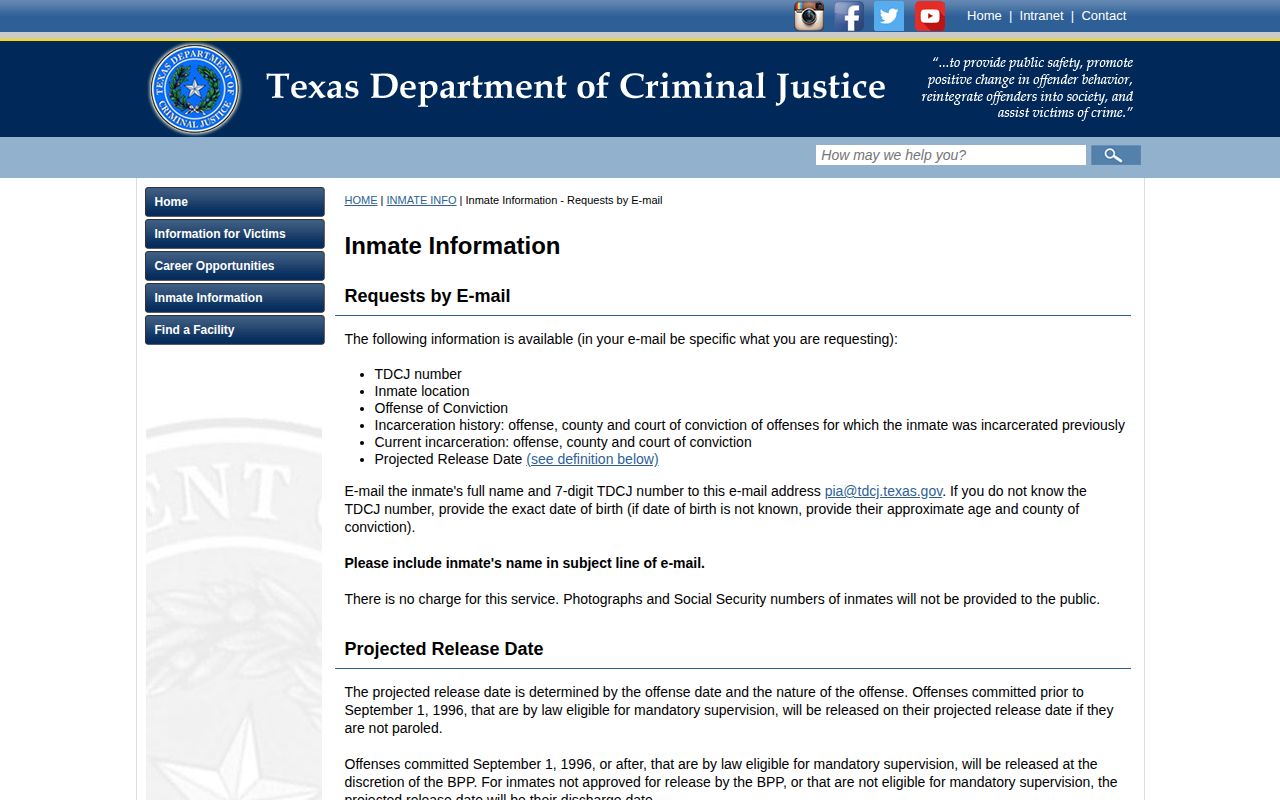
The capture documents the official state field and fallback request route. It does not describe a McMullen county-jail calculation.
The online search is mainly a current-inmate tool, not a full archive of all former prisoners. If a released person no longer appears, request incarceration history and release information through TDCJ with the full name, seven-digit TDCJ number when known, or date of birth and county of conviction. A missing result cannot establish that the person never entered state custody.
County of conviction also differs from current unit, release gate, and approved residence. A McMullen judgment can lead to confinement elsewhere in Texas. Confirm the current TDCJ unit and any scheduled release location from the detail rather than assuming release takes place in McMullen County.
McMullen TDCJ Good-Time Rules
Texas good-conduct time for TDCJ prisoners is governed mainly by Government Code Chapter 498. Section 498.003 directs awards based on classification and permits certain diligent-participation credits. Section 498.004 states that good conduct time is a privilege, not a right. It can be forfeited for misconduct, and restoration is discretionary under agency rules.
Good time does not simply subtract a fixed amount from every sentence. It can affect parole eligibility or mandatory-supervision computation when the case qualifies. Under Government Code Chapter 508, offense category, offense date, sentence, and exclusions determine which formula applies. Section 508.149 lists categories excluded from mandatory supervision.
Some offenses covered by the statute generally require actual calendar time equal to one-half of the sentence or 30 years, whichever is less, subject to a two-year minimum and the exact subsection. Other eligible cases may reach parole eligibility when calendar time plus good time equals one-fourth of the sentence or 15 years, whichever is less. Eligibility is not release.
Texas has no blanket rule requiring every state prisoner to serve 85 percent. That shortcut is often drawn from federal practice and should not be applied to a TDCJ case. A real estimate must use the current law tied to the offense date and category.
For offenses before September 1, 1996 that remain eligible for mandatory supervision, TDCJ says release occurs on the projected date if parole has not happened sooner. For later eligible offenses, discretionary mandatory supervision includes Board review. If release is denied or the person is not eligible, TDCJ describes the projected date as the discharge date. Those rules still depend on the person’s exact offense date and record.
McMullen County Good-Time Calculation
No McMullen County good-time formula is published online. This is not a gap to fill with the TDCJ formula. Local Government Code Section 351.041 gives a sheriff authority to award commutation for good conduct to qualifying county prisoners within statutory limits. Texas Code of Criminal Procedure Article 42.03 also addresses jail-time credit.
The local date depends on the signed judgment, credited time, the Sheriff’s actual computation, statutory exclusions, court orders, and any other hold. Because McMullen detainees may be housed outside the county, both the originating Sheriff and physical housing jail may hold part of the answer. Ask which agency performs the calculation and request that existing record.
This county-and-state split is decisive. A TDCJ projected date comes from state Classification and Records. A McMullen county sentence remains a local calculation even if an online state formula looks easier to apply. Never estimate an exact door date from sentence length alone.
Note: Request the existing calculation and its date because a custodian need not create a new report to answer a Public Information Act request.
Why McMullen Release Dates Change
A projection can move as the official record changes. TDCJ warns that even a scheduled date may change without notice, including on the planned release day. A county estimate can also change when the court, Sheriff, housing jail, or another custodian supplies new controlling information.
| Factor | Possible effect | Best confirmation |
|---|---|---|
| Sentence or jail-credit correction | Moves the computed endpoint | Judgment, amended order, and records calculation |
| Concurrent or consecutive sentences | Changes how multiple terms run | Sentencing documents and agency audit |
| Good-time forfeiture or classification | Changes eligible credit in TDCJ | TDCJ Classification and Records |
| Parole or mandatory-supervision action | May permit earlier release or continue review | BPP status and TDCJ detail |
| Detainer or warrant | Can cause transfer instead of community release | Holding agency and release disposition |
| New case, appeal, or court order | Can add, remove, or alter custody authority | Signed court record |
| Release-plan or program review | Can delay a scheduled state release | TDCJ release audit and posted detail |
A change is not necessarily an error. Record the date on which each source was checked and identify the agency that supplied it.
McMullen Pretrial Release Timing
A pretrial detainee has not begun serving a sentence in the pending case. There is therefore no sentence-based projected release date to calculate. Bond terms, a personal bond, dismissal, court action, jail processing, and unrelated holds can each control whether and when the person leaves.
The combined McMullen County/District Clerk can provide the docket, bond order, and signed disposition. Those records explain the legal authority, but they may not record the instant of physical departure. The housing jail’s admission and release log should supply that timestamp. A bond order signed in court can precede release processing by hours.
Absence from a current roster is not enough. It can reflect transfer, delayed data, confidentiality, or a different housing county. Ask for an affirmative release date and disposition.
A court dismissal may explain why legal custody should end, but it does not log the moment the jail opened the door or clear an unrelated hold. Release on bond also leaves the criminal case pending. Match the signed court act with the housing jail’s later physical-release entry.
Confirm McMullen Actual Release
For TDCJ, check the offender detail again after the expected date and request release or incarceration history if the online search no longer shows the former prisoner. For county custody, ask McMullen Sheriff to identify the physical jail, then obtain that jail’s release time, authority, reason, and destination. Use the clerk’s signed order to explain the case result.
Current notification tools can help track the change. Texas now uses IVSS-Counties for participating county events and a separate TDCJ IVSS for prison and supervision events. The familiar VINELink name is historical. Registration steps and system limits are covered in the McMullen County VINELink check.
The TDCJ inmate-information page shows the official state lookup choices in the capture below.
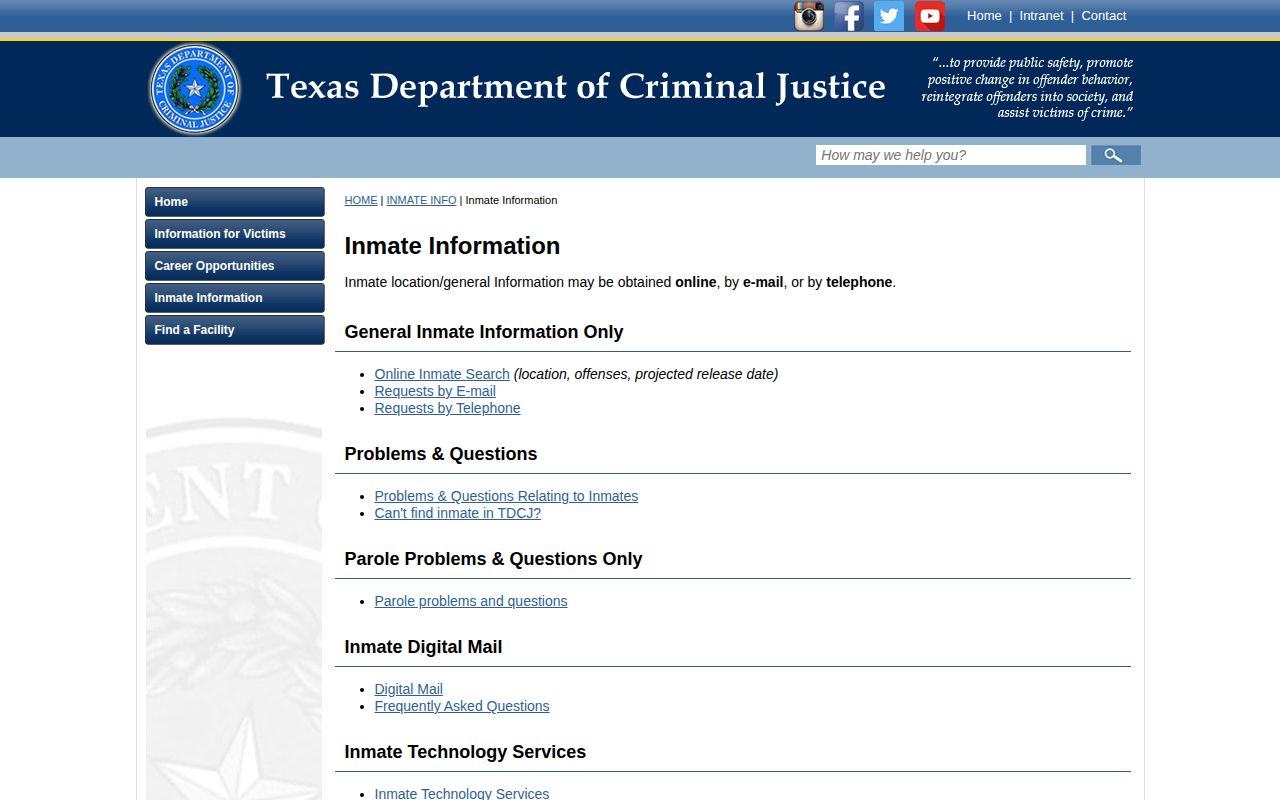
Those state channels apply only to TDCJ custody. A McMullen county-only release still requires the Sheriff, housing jail, and court trail.